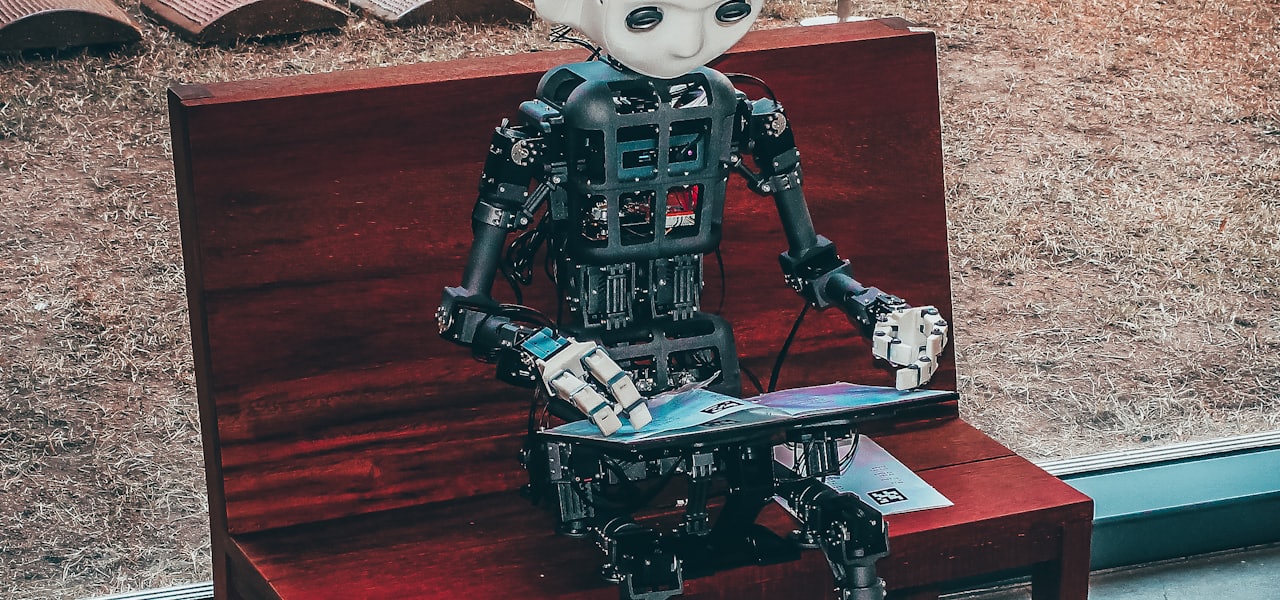
Albert One is an artificial intelligence chatbot created by Robby Garner and designed to mimic the way humans make conversations using a multi-faceted approach in natural language programming. == History == In both 1998 and 1999, Albert One won the Loebner Prize Contest, a competition between chatterbots. Some parts of Albert were deployed on the internet beginning in 1995, to gather information about what kinds of things people would say to a chatterbot. Another element of Albert One involved the building of a large database of human statements, and associated replies. This portion of the project was tested at the 1994-1997 Loebner Prize contests. Albert was the first of Robby Garner's multifaceted bots. The Albert One system was composed of several subsystems. Among those were a version of Eliza, the therapist, Elivs, another Eliza-like bot, and several other helper applications working together in a hierarchical arrangement. As a continuation of the stimulus-response library, various other database queries and assertions were tested to arrive at each of Albert's responses. Robby went on to develop networked examples of this kind of hierarchical "glue" at The Turing Hub.
Internet Security Awareness Training
Internet Security Awareness Training (ISAT) is the training given to members of an organization regarding the protection of various information assets of that organization. ISAT is a subset of general security awareness training (SAT). Even small and medium enterprises are generally recommended to provide such training, but organizations that need to comply with government regulations (e.g., the Gramm–Leach–Bliley Act, the Payment Card Industry Data Security Standard, Health Insurance Portability and Accountability Act, Sarbanes–Oxley Act) normally require formal ISAT for annually for all employees. Often such training is provided in the form of online courses. ISAT, also referred to as Security Education, Training, and Awareness (SETA), organizations train and create awareness of information security management within their environment. It is beneficial to organizations when employees are well trained and feel empowered to take important actions to protect themselves and organizational data. The SETA program target must be based on user roles within organizations and for positions that expose the organizations to increased risk levels, specialized courses must be required. == Coverage == There are general topics to cover for the training, but it is necessary for each organization to have a coverage strategy based on its needs, as this will ensure the training is practical and captures critical topics relevant to the organization. As the threat landscape changes very frequently, organizations should continuously review their training programs to ensure relevance with current trends. Topics covered in ISAT include: Appropriate methods for protecting sensitive information on personal computer systems, including password policy Various computer security concerns, including spam, malware, phishing, social engineering, etc. Consequences of failure to properly protect information, including potential job loss, economic consequences to the firm, damage to individuals whose private records are divulged, and possible civil and criminal law penalties. Being Internet Security Aware means you understand that there are people actively trying to steal data that is stored within your organization's computers. (This often focuses on user names and passwords, so that criminal elements can ultimately get access to bank accounts and other high-value IT assets.) That is why it is important to protect the assets of the organization and stop that from happening. The general scope should include topics such as password security, Email phishing, Social engineering, Mobile device security, Sensitive data security, and Business communications. In contrast, those requiring specialized knowledge are usually required to take technical and in-depth training courses. Suppose an organization determines that it is best to use one of the available training tools on the market, it must ensure it sets objectives that the training can meet, including confirming the training will provide employees with the knowledge to understand risks and the behaviors needed in managing them, actions to take to prevent or detect security incidents, using language easily understandable by the trainees, and ensuring the pricing is reasonable. Organizations are recommended to base ISAT training content on employee roles and their culture; the policy should guide that training for all employees and gave the following as examples of sources of reference materials: National Institute of Standards and Technology (NIST) Special Publication 800-50, Building an Information Technology Security Awareness and Training Program International Standards Organization (ISO) 27002:2013, Information technology—Security techniques—Code of practice for information security controls International Standards Organization (ISO) 27001:2013, Information technology — Security techniques — Information security management systems COBIT 5 Appendix F.2, Detailed Guidance: Services, Infrastructure and Applications Enabler, Security Awareness The training must focus on current threats specific to an organization and the impacts if that materializes as a result of user actions. Including practical examples and ways of dealing with scenarios help users know the appropriate measures to take. It is a good practice to periodically train customers of specific organizations on threats they face from people with malicious intentions. Coverage strategy for SAT should be driven by an organization's policy. It can help truly determine the level of depth of the training and where it should be conducted at a global level or business unit level, or a combination of both. A policy also empowers a responsible party within the organization to run the training. == Importance == Studies show that well-structured security awareness training can significantly reduce the likelihood of cyber incidents caused by human error. According to the Ponemon Institute, organizations that implement regular security training experience up to 70% fewer successful phishing attacks. Additionally, a 2023 Verizon Data Breach Investigations Report found that 74% of breaches involve the human element, highlighting the need for continuous education. Employees are key in whether organizations are breached or not; there must be a policy on creating awareness and training them on emerging threats and actions to take in safeguarding sensitive information and reporting any observed unusual activity within the corporate environment. Research has shown that SAT has helped reduce cyber-attacks within organizations, especially when it comes to phishing, as trainees learned to identify these attack modes and give them the self-assurance to take action appropriately. There is an increase in phishing attacks, and it has become increasingly important for people to understand how to these attacks work, and the actions required to prevent these and SAT has shown a significant impact on the number of successful phishing attacks against organizations. == Compliance Requirements == Various regulations and laws mandate SAT for organizations in specific industries, including the Gramm–Leach–Bliley Act (GLBA) for the financial services, the Federal Information Security Modernization Act of 2014 for federal agencies, and the European Union's General Data Protection Regulation (GDPR). === Federal Information Security Modernization Act === Employees and contractors in federal agencies are required to receive Security Awareness Training annually, and the program needs to address job-related information security risks linked that provide them with the knowledge to lessen security risks. === Health Insurance Portability and Accountability Act === The Health Insurance Portability and Accountability Act has the Security Rule, and Privacy Rule requiring the creation of a security awareness training program and ensuring employees are trained accordingly. === Payment Card Industry Data Security Standard === The Payment Card Industry Security Standards Council, the governing council for stakeholders in the payment industry, formed by American Express, Discover, JCB International, MasterCard, and Visa that developed the DSS as a requirement for the payment industry. Requirement 12.6 requires member organizations to institute a formal security awareness program. There is a published guide for organizations to adhere to when setting up the program. === US States Training Regulations === Some States mandate Security Awareness Training whiles other do not but simply recommend voluntary training. Among states that require the training for its employees include: Colorado (The Colorado Information Security Act, Colorado Revised Statutes 24-37.5-401 et seq.) Connecticut (13 FAM 301.1-1 Cyber Security Awareness Training (PS800)) Florida (Florida Statutes Chapter 282) Georgia (Executive Order GA E.O.182 mandated training within 90 days of issue) Illinois (Cook County) Indiana (IN H 1240) Louisiana (Louisiana Division of Administration, Office of Technology Services p. 52: LA H 633) Maryland (20-07 IT Security Policy) Montana (Mandatory cyber training for executive branch state employees) Nebraska Nevada (agency-by-agency state employee requirement - State Security Standard 123 – IT Security) New Hampshire New Jersey ( NJ A 1654) North Carolina Ohio (IT-15 - Security Awareness and Training) Pennsylvania Texas Utah Vermont Virginia West Virginia (WV Code Section 5A-6-4a) == Training Techniques == Below are some common training techniques, even though some can be blended depending on the operating environment: Interactive video training – This technique allows users to be trained using two-way interactive audio and video instruction. Web-based training – This method allows employees or users to take the training independently and usually has a testing component to determine if learning has taken place. If not, users can be allowed to retake the course and test to ensure there is a complete understanding
Algorithmic radicalization
Algorithmic radicalization is the concept that recommender algorithms on popular social media sites, such as YouTube and Facebook, drive users toward progressively more extreme content over time, leading to the development of radicalized extremist political views. Algorithms meticulously record user interactions, encompassing likes, dislikes and the duration of time watching content, with the objective of generating an endless stream of media designed to sustain user engagement. The phenomenon of echo chamber channels has been demonstrated to exacerbate the polarization of consumers, primarily through the reinforcement of media preferences and the validation of one's existing beliefs. Algorithmic radicalization remains a controversial phenomenon as it is often not in the best interest of social media companies to remove echo chamber channels. To what extent recommender algorithms are actually responsible for radicalization remains disputed. Studies have found contradictory results regarding the promotion of extremist content by algorithms. == Social media echo chambers and filter bubbles == Social media platforms learn the interests and likes of the user to modify their experiences in their feed to keep them engaged and scrolling, known as a filter bubble. An echo chamber is formed when users come across beliefs that magnify or reinforce their thoughts and form a group of like-minded users in a closed system. Echo chambers spread information without any opposing beliefs and can possibly lead to confirmation bias. According to group polarization theory, an echo chamber can potentially lead users and groups towards more extreme radicalized positions. According to the National Library of Medicine, "Users online tend to prefer information adhering to their worldviews, ignore dissenting information, and form polarized groups around shared narratives. Furthermore, when polarization is high, misinformation quickly proliferates." == By site == === Facebook === Facebook's algorithm focuses on recommending content that makes the user want to interact. They rank content by prioritizing popular posts by friends, viral content, and sometimes divisive content. Each feed is personalized to the user's specific interests which can sometimes lead users towards an echo chamber of troublesome content. Users can find their list of interests the algorithm uses by going to the "Your ad Preferences" page. According to a Pew Research study, 74% of Facebook users did not know that list existed until they were directed towards that page in the study. It is also relatively common for Facebook to assign political labels to their users. In recent years, Facebook has started using artificial intelligence to change the content users see in their feed and what is recommended to them. A document known as The Facebook Files has revealed that their AI system prioritizes user engagement over everything else. The Facebook Files has also demonstrated that controlling the AI systems has proven difficult to handle. In an August 2019 internal memo leaked in 2021, Facebook has admitted that "the mechanics of our platforms are not neutral", concluding that in order to reach maximum profits, optimization for engagement is necessary. In order to increase engagement, algorithms have found that hate, misinformation, and politics are instrumental for app activity. As referenced in the memo, "The more incendiary the material, the more it keeps users engaged, the more it is boosted by the algorithm." According to a 2018 study, "false rumors spread faster and wider than true information... They found falsehoods are 70% more likely to be retweeted on Twitter than the truth, and reach their first 1,500 people six times faster. This effect is more pronounced with political news than other categories." === YouTube === YouTube has been around since 2005 and has more than 2.5 billion monthly users. YouTube discovery content systems focus on the user's personal activity (watched, favorites, likes) to direct them to recommended content. YouTube's algorithm is accountable for roughly 70% of users' recommended videos and what drives people to watch certain content. According to a 2022 study by the Mozilla Foundation, users have little power to keep unsolicited videos out of their suggested recommended content. This includes videos about hate speech, livestreams, etc. YouTube has been identified as an influential platform for spreading radicalized content. Al-Qaeda and similar extremist groups have been linked to using YouTube for recruitment videos and engaging with international media outlets. In a research study published by the American Behavioral Scientist Journal, they researched "whether it is possible to identify a set of attributes that may help explain part of the YouTube algorithm's decision-making process". The results of the study showed that YouTube's algorithm recommendations for extremism content factor into the presence of radical keywords in a video's title. In February 2023, in the case of Gonzalez v. Google, the question at hand is whether or not Google, the parent company of YouTube, is protected from lawsuits claiming that the site's algorithms aided terrorists in recommending ISIS videos to users. Section 230 is known to generally protect online platforms from civil liability for the content posted by its users. Multiple studies have found little to no evidence to suggest that YouTube's algorithms direct attention towards far-right content to those not already engaged with it. === TikTok === TikTok is a platform that recommends videos to a user's 'For You Page' (FYP), making every users' page different. With the nature of the algorithm behind the app, TikTok's FYP has been linked to showing more explicit and radical videos over time based on users' previous interactions on the app. Since TikTok's inception, the app has been scrutinized for misinformation and hate speech as those forms of media usually generate more interactions to the algorithm. Various extremist groups, including jihadist organizations, have utilized TikTok to disseminate propaganda, recruit followers, and incite violence. The platform's algorithm, which recommends content based on user engagement, can expose users to extremist content that aligns with their interests or interactions. As of 2022, TikTok's head of US Security has put out a statement that "81,518,334 videos were removed globally between April – June for violating our Community Guidelines or Terms of Service" to cut back on hate speech, harassment, and misinformation. Studies have noted instances where individuals were radicalized through content encountered on TikTok. For example, in early 2023, Austrian authorities thwarted a plot against an LGBTQ+ pride parade that involved two teenagers and a 20-year-old who were inspired by jihadist content on TikTok. The youngest suspect, 14 years old, had been exposed to videos created by Islamist influencers glorifying jihad. These videos led him to further engagement with similar content, eventually resulting in his involvement in planning an attack. Another case involved the arrest of several teenagers in Vienna, Austria, in 2024, who were planning to carry out a terrorist attack at a Taylor Swift concert. The investigation revealed that some of the suspects had been radicalized online, with TikTok being one of the platforms used to disseminate extremist content that influenced their beliefs and actions. == Self-radicalization == The U.S. Department of Justice defines 'Lone-wolf' (self) terrorism as "someone who acts alone in a terrorist attack without the help or encouragement of a government or a terrorist organization". Through social media outlets on the internet, 'Lone-wolf' terrorism has been on the rise, being linked to algorithmic radicalization. Through echo-chambers on the internet, viewpoints typically seen as radical were accepted and quickly adopted by other extremists. These viewpoints are encouraged by forums, group chats, and social media to reinforce their beliefs. == References in media == === The Social Dilemma === The Social Dilemma is a 2020 docudrama about how algorithms behind social media enables addiction, while possessing abilities to manipulate people's views, emotions, and behavior to spread conspiracy theories and disinformation. The film repeatedly uses buzz words such as 'echo chambers' and 'fake news' to prove psychological manipulation on social media, therefore leading to political manipulation. In the film, Ben falls deeper into a social media addiction as the algorithm found that his social media page has a 62.3% chance of long-term engagement. This leads into more videos on the recommended feed for Ben and he eventually becomes more immersed into propaganda and conspiracy theories, becoming more polarized with each video. == Proposed solutions == === United States: Weakening Section 230 protections === In the Communications Decency Act, Section 230 states t
Boba liberal
Boba liberal is a term mostly used within the Asian diaspora communities in the West, especially in the United States. It describes someone of East or Southeast Asian descent living in the West who has a shallow, surface-level liberal outlook. It is also occasionally used to describe conservatives who weaponize their East or Southeast Asian identity. The neologism emerged among the Asian American leftist community on Twitter who accused "boba liberals" of only holding their liberal beliefs to appear more white-adjacent by engaging in progressive social movements or viewpoints, while at the same time disregarding and trivializing issues concerning Asians. Mary Chao, writing for The North Jersey Record, said that "Asians call peers boba liberals when they aspire to liberal whiteness." An article in The Yale Herald described it as a term "used to describe the ethnocentric politics of Asian Americans, usually of East Asian descent, who exclusively advocate for issues that benefit themselves, without acknowledging problematic dimensions of their own history and working to support other people of color." The feminist magazine Fem said that "the faces of boba liberalism are Asian Americans that are part of the middle and upper economic class. As a result, boba liberals disregard the negative effects of capitalism because they profit from it. For instance, boba liberals tend to focus on advocating for Asian representation in white spaces, or discussing whether or not wearing chopsticks in one's hair is culture appropriation. These topics are popular within boba liberal circles, all while dialogue regarding inequality, globalization, and racial injustice are purposely neglected." UnHerd notes that conservative Asian Americans have used the term not to critique capitalism, but to "aim at a small but influential group of progressive Asian-American activists who are supposedly selling out other Asians, especially working-class Asians, in order to win brownie points from elite, generally white liberals." MRAsians have similarly used the term to attack Asian American feminists who supported the Black Lives Matter movement. The Asian identity of boba liberals has often been accused of being shallow and superficial. Boba liberals are accused of using surface-level stereotypical Asian traits such as liking boba tea to bolster their Asian credentials. Plan A Magazine, an Asian diaspora magazine, described the film Crazy Rich Asians and the sitcom Fresh Off the Boat as "boba liberal media", calling them the result of "a specific kind of atomized identity politics". Other media outlets have connected the Crazy Rich Asians film to boba liberalism. == Controversy == The term "boba liberal" was coined in 2019 by Vietnamese American Twitter user Redmond (@diaspora_is_red) to analyze a form of Asian American liberalism through a Marxist lens. Redmond has criticized the misappropriation of their neologism by stripping away the Marxist framework by failing to discuss "socialism, communism, the capitalist system, imperialism, and the diaspora bourgeoisie" and conflating "boba liberalism" with the flawed concept of "East Asian privilege". In 2024, Redmond criticized misuse of the term by conservatives and liberals, and said "The term boba liberalism can go away for all I care. It's corny and stale". === United States === One commentator described boba liberals as supporting policies that primarily benefit upper-income Asian-Americans, and not necessarily the Asian-American community as a whole. Therefore, while the word "liberal" is used in the term, it is not mutually exclusive to one specific ideology, as it may also extend to conservative-aligned Asians in some areas, as they would often take advantage of the "model minority" label by defending such measures.
Digital scrapbooking
Digital scrapbooking is the term for the creation of a new 2D artwork by re-combining various graphic elements. It is a form of scrapbooking that is done using a personal computer, digital or scanned photos and computer graphics software. It is a relatively new form of the traditional print scrapbooking. Recent advances in technology now enable the craft to be pursued on tablets and smart devices utilising imaging apps as well as hobby specific apps, some of which have been created specifically by brands for use with their own image products. Digital scrapbooking kits are available to purchase and download at many websites that specialize in the craft. Kits contain graphics and word-art and are usually themed and color-coordinated. They usually consist of a mix of background images and "cut out" [extracted] images containing alpha channels. Once a kit has been downloaded to the computer or device, it can then be used over and over again to make new scrapbook pages (scrapbook layouts) within the software program that one chooses to use, often in combination with the users's own family photographs, scanned keepsakes and other unique personal elements scanned on a flatbed scanner. Scanning is usually done at 300dpi, to make the resulting images suitable for print. == Licensing and Copyright == Kits are sometimes licensed differently from other forms of traditional royalty-free stock images that may be purchased per-item or in sets at online stock photography sites. Some kit packs will be wholly royalty-free, but some kit makers may restrict usage to non-commercial work only. Some may specifically forbid the use of their work in projects for commercial gain, for example greetings cards and gift tags that may be made with their kits. Licensing often varies from kit to kit, even from the same maker. Some kits include derivative works of public domain material. In contrast to stock, creators of digital scrapbooking kits often require a credit or byline to indicate that their image elements have been used in a new creation. == Uses == Some artistic individuals combine digital scrapbooking with traditional scrapbooking to create what's known as hybrid scrapbooking projects. Hybrid scrapbooking involves creating layouts on the computer using digital supplies that will then be printed and combined with traditional supplies such as buttons, ribbons and other elements. Conversely, a hybrid scrapbook project may also be created using traditional paper supplies and augmented with digital elements that have been printed and cut out specifically for use on the project. Journaling may be done within the software programs to accompany images and to create digital storybooks, or scrapbooks, which are then published in photo books via various popular print-on-demand services, printed and added to traditional scrapbooks, burned to CDs or posted on the Web. Digital Scrapbooking may also be done online by uploading photos to a specialist scrapbooking website and utilising their custom built platforms and decorative image elements to complete the projects for print to finished products, for example photo books and holiday greeting cards. == Market Size == The traditional scrapbooking market appeared to decline somewhat in the USA since 2010, probably due to the 2008 financial crisis, and the digital scrapbooking market (being potentially a much cheaper form of scrapbooking) may have increased accordingly. Both markets currently appear to have recovered lost ground and expanded since the beginning of the COVID-19 pandemic as many people sought to productively fill their time during lockdowns, quarantines and self-isolation / stay at home directions. == Digital scrapbooking software == The main software programs that are typically used are Adobe Photoshop, Adobe Photoshop Elements, paint.net (freeware), Filter Forge, Corel Paintshop Pro, and GIMP. Additionally Adobe offer the Photoshop iOS product using the same code base as the desktop version to drive the app version. == Digital scrapbooking supplies == Digital scrapbooking supplies are downloaded from the Internet and then stored on a computer or external hardrive, DVD or CD media, SD cards, or in the cloud, to be used as needed. Both paid and free digital scrapbooking supplies available from numerous designers on their blogs or in e-commerce stores either as solo designers or as part of a wide cohort of designers working cooperatively in large full service e-commerce websites. Usually designed at 300ppi image resolution, digital scrapbooking product offerings and supplies often include: Full coordinated kits containing digital background “papers”, decorative alphabets, and diverse embellishments generally containing a mixture of .JPG and .PNG files; "Quick pages", flattened files containing a completed page layout with transparent photo windows in .PNG file format; Digital templates, fully layered layouts i.e. pages that have had the composition pre-designed ready for use in an imaging program or app, fully customizable for color schemes, kit choices, photographs and other embellishments, generally supplied in either .PSD or .TIF file format; Hybrid “quick pages”, i.e. layouts that are both fully designed and fully layered for customization, generally supplied in either .PSD or .TIF file format; Adobe Photoshop actions, brushes, custom shapes, paths and styles, saved in their respective native Photoshop file formats; and Corel PaintShop Pro equivalent tools.
Opponent process
The opponent process is a hypothesis of color vision that states that the human visual system interprets information about color by processing signals from the three types of photoreceptor cells in an antagonistic manner. The three types of cones are called L, M, and S. The names stand for "Long wavelength sensitive,” "middle wavelength sensitive," and "short wavelength sensitive." The opponent-process theory implicates three opponent channels: L versus M, S versus (L+M), and a luminance channel (+ versus -). These cone-opponent mechanisms were at one time thought to be the neural substrate for a psychological theory called Hering's Opponent Colors Theory, which calls for three psychologically important opponent color processes: red versus green, blue versus yellow, and black versus white (luminance). The Opponent Colors Theory is named for the German physiologist Ewald Hering who proposed the idea in the late 19th century. However, it has been argued that Hering’s Opponent Colors Theory lacks adequate phenomenological and empirical support, and may not be a necessary feature of normal human color experience. Correspondingly, considerable physiological and behavioral evidence proves that the physiological cone opponent mechanisms do not constitute the neurobiological basis for Hering's Opponent Colors Theory. == Color theory == === Complementary colors === When staring at a bright color for a while (e.g. red), then looking away at a white field, an afterimage is perceived, such that the original color will evoke its complementary color (cyan, in the case of red input). When complementary colors are combined or mixed, they "cancel each other out" and become neutral (white or gray). That is, complementary colors are never perceived as a mixture; there is no "greenish red" or "yellowish blue", despite claims to the contrary. The strongest color contrast that a color can have is its complementary color. Complementary colors may also be called "opposite colors" and they were originally considered the primary evidence in support of Hering's Opponent Colors Theory. There are two fatal problems with this evidence. First, the complement of red is not green, as called for by Hering's theory; it is bluish-green. And second, there exists a complementary color for every color, so there is nothing special about the set of complementary pairs picked out by Hering's theory. === Unique hues === The colors that define the extremes for each opponent channel are called unique hues, as opposed to composite (mixed) hues. Ewald Hering first defined the unique hues as red, green, blue, and yellow, and based them on the concept that these colors could not be simultaneously perceived. For example, a color cannot appear both red and green. These definitions have been experimentally refined and are represented today by average hue angles of 353° (carmine red), 128° (cobalt green), 228° (cobalt blue), 58° (yellow). The unique hues are a defining feature of many psychological color spaces, but there is substantial evidence showing that the unique hues are not hard wired in the nervous system, contrary to the stipulations of Hering's Opponent Colors Theory. Unique hues can differ between individuals and are often used in psychophysical research to measure variations in color perception due to color-vision deficiencies or color adaptation. While there is considerable inter-subject variability when defining unique hues experimentally, an individual's unique hues are very consistent, to within a few nanometers of wavelength. == Physiological basis == === Relation to LMS color space === The trichromatic theory is in conflict with Hering's Opponent Colors Theory, although it is compatible with a physiological opponent process that compares the outputs of the different classes of cone types. The poles of these cone opponent mechanisms do not correspond to the unique hues of Hering's Opponent Colors Theory and unlike the unique hues, have no privilege in color perception. Most humans have three different cone cells in their retinas that facilitate trichromatic color vision. Colors are determined by the proportional excitation of these three cone types, i.e. their quantum catch. The levels of excitation of each cone type are the parameters that define LMS color space. To calculate the opponent process tristimulus values from the LMS color space, the cone excitations must be compared: The luminous (achromatic) opponent channel is a weighted sum of all three cone cells (plus the rod cells in some conditions). The red–green opponent channel is equal to the difference of the L- and M-cones. The blue–yellow opponent channel is equal to the difference of the S-cone and the average/weighted sum of the L- and M-cones. Most mammals have no L cone (the primate L cone arose from a gene duplication of the M cone opsin gene). These mammals still show two kinds of opponent channels in their retinal ganglion cells: the achromatic channel and the blue-yellow opponency channel. === Cone opponent mechanisms are encoded in the retina === The output of different types of cones are compared by cells in the retina including retina bipolar cells (which compare signals from L and M cones) and bistratified retinal ganglion cells (which compare S cone signals with L and M cone signals). The output of bipolar cells is relayed to the visual cortex by the retinal ganglion cells (RGCs) by way of a thalamic relay station called the lateral geniculate nucleus (LGN) of the thalamus. Much of the scientific knowledge of retinal ganglion cell physiology was obtained by neural recordings of cells in the LGN. The cone-opponent mechanisms in the retina and LGN represent a fundamental physiological opponent process but do not represent the unique hues (or Hering's Opponent Colors Theory). For example, the colors that best elicit responses of the bistratified S-(L+M)-opponent neurons are best described as purplish (or lavender) and lime-green, not "blue" and "yellow". The neurons are sometimes referred to as "blue–yellow" neurons, but this is a historical artifact dating to the time when it was thought that Hering's Opponent Colors Theory was hardwired by the retina and the mismatch between the colors to which they are optimally tuned and Hering's Opponent Colors was overlooked. Cone opponent mechanisms exist in the retinas of many mammals, including monkeys, mice, and cats. In primates, the LGN contains three major classes of layers: Magnocellular layers (M, large-cell) – responsible largely for the luminance channel Parvocellular layers (P, small-cell) – responsible largely for red–green opponency Koniocellular layers (K) – responsible largely for blue–yellow opponency, poor spatial resolution, long latency Other mammals such as cats also have three cell types denoted as X (magno), Y (parvo), and W (konio). The W type is beyond most doubt homologous to the primate K type. There are some subtle differences between the M and X types as well as the Y and P types to make the correspondence unclear. === Advantage === Transmitting information in opponent-channel color space could be advantageous over transmitting it in LMS color space ("raw" signals from each cone type). There is some overlap in the wavelengths of light to which the three types of cones (L for long-wave, M for medium-wave, and S for short-wave light) respond, so it is more efficient for the visual system (from a perspective of dynamic range) to record differences between the responses of cones, rather than each type of cone's individual response. Hurvich and Jameson argued that the use of opponent-channel color space would increase color contrast, making the information easier to process by later stages of vision. === Color blindness === Color blindness can be classified by the cone cell that is affected (protan, deutan, tritan) or by the opponent channel that is affected (red–green or blue–yellow). In either case, the channel can either be inactive (in the case of dichromacy) or have a lower dynamic range (in the case of anomalous trichromacy). For example, individuals with deuteranopia see little difference between the red and green unique hues. == History == Johann Wolfgang von Goethe first studied the physiological effect of opposed colors in his Theory of Colours in 1810. Goethe arranged his color wheel symmetrically "for the colours diametrically opposed to each other in this diagram are those which reciprocally evoke each other in the eye. Thus, yellow demands purple; orange, blue; red, green; and vice versa: Thus again all intermediate gradations reciprocally evoke each other." Ewald Hering proposed opponent color theory in 1892. He thought that the colors red, yellow, green, and blue are special in that any other color can be described as a mix of them, and that they exist in opposite pairs. That is, either red or green is perceived and never greenish-red: Even though yellow is a mixture of red and green in the RGB color theory, humans
Plug compatibility
Plug compatibility is a characteristic of computer hardware that performs exactly like that of another vendor. Manufacturers who made replacements for IBM peripherals were referred to as plug-compatible manufacturers (PCMs). Later plug-compatible mainframe (also PCM) referred to IBM-compatible mainframe computers. PCM can also mean plug-compatible machine or plug-compatible module. == Plug compatibility and peripherals == Before the rise of the plug-compatible peripheral industry, computing systems were either configured with peripherals designed and built by the CPU vendor or designed to use vendor-selected rebadged devices. The first examples of plug-compatible IBM subsystems were tape drives and controls offered by Telex beginning 1965. Memorex in 1968 was first to enter the IBM plug-compatible disk market, followed shortly thereafter by a number of suppliers such as CDC, Itel, and Storage Technology Corporation. This was boosted by the world's largest user of computing equipment, the US General Services Administration, buying plug-compatible equipment. Eventually there were third-party plug-compatible alternatives to most first-party peripherals and first-party system main memory. == Plug compatibility and computer systems == A plug-compatible machine is one that is backward compatible with a prior machine. In particular, a new computer system that is plug-compatible has not only the same connectors and protocol interfaces to peripherals, but also binary-code compatibility—it runs the same software as the old system. A plug compatible manufacturer, or PCM, is a company that makes such products. One recurring theme in plug-compatible systems is the ability to be bug compatible as well. That is, if the forerunner system had software or interface problems, then the successor must have (or simulate) the same problems. Otherwise, the new system may generate unpredictable results, defeating the objective of full compatibility. Thus, it is important for customers to understand the difference between a bug and a feature, where the latter is defined as an intentional modification to the previous system (e.g. higher speed, lighter weight, smaller package, better operator controls, etc.). === Plug compatibility and IBM mainframes === The original example of plug-compatible mainframes was the Amdahl 470 mainframe computer which was plug-compatible with the IBM System 360 and 370, costing millions of dollars to develop. Similar systems were available from Comparex, Fujitsu, and Hitachi. Not all were large systems. Most of these system vendors eventually left the PCM market. In late 1981, there were eight PCM companies, and collectively they had 36 IBM-compatible models. == Non-computer usage of plug compatibility == Plug compatibility may also be used to describe replacement criteria for other components available from multiple sources. For example, a plug-compatible cooling fan may need to have not only the same physical size and shape, but also similar capability, run from the same voltage, use similar power, attach with a standard electrical connector, and have similar mounting arrangements. Some non-conforming units may be re-packaged or modified to meet plug-compatible requirements, as where an adapter plate is provided for mounting, or a different tool and instructions are supplied for installation, and these modifications would be reflected in the bill of materials for such components. Similar issues arise for computer system interfaces when competitors wish to offer an easy upgrade path. In general, plug-compatible systems are designed where industry or de facto standards have rigorously defined the environment, and there is a large installed population of machines that can benefit from third-party enhancements. Plug compatible does not mean identical. However, nothing prevents a company from developing follow-on products that are backward-compatible with its own early products.